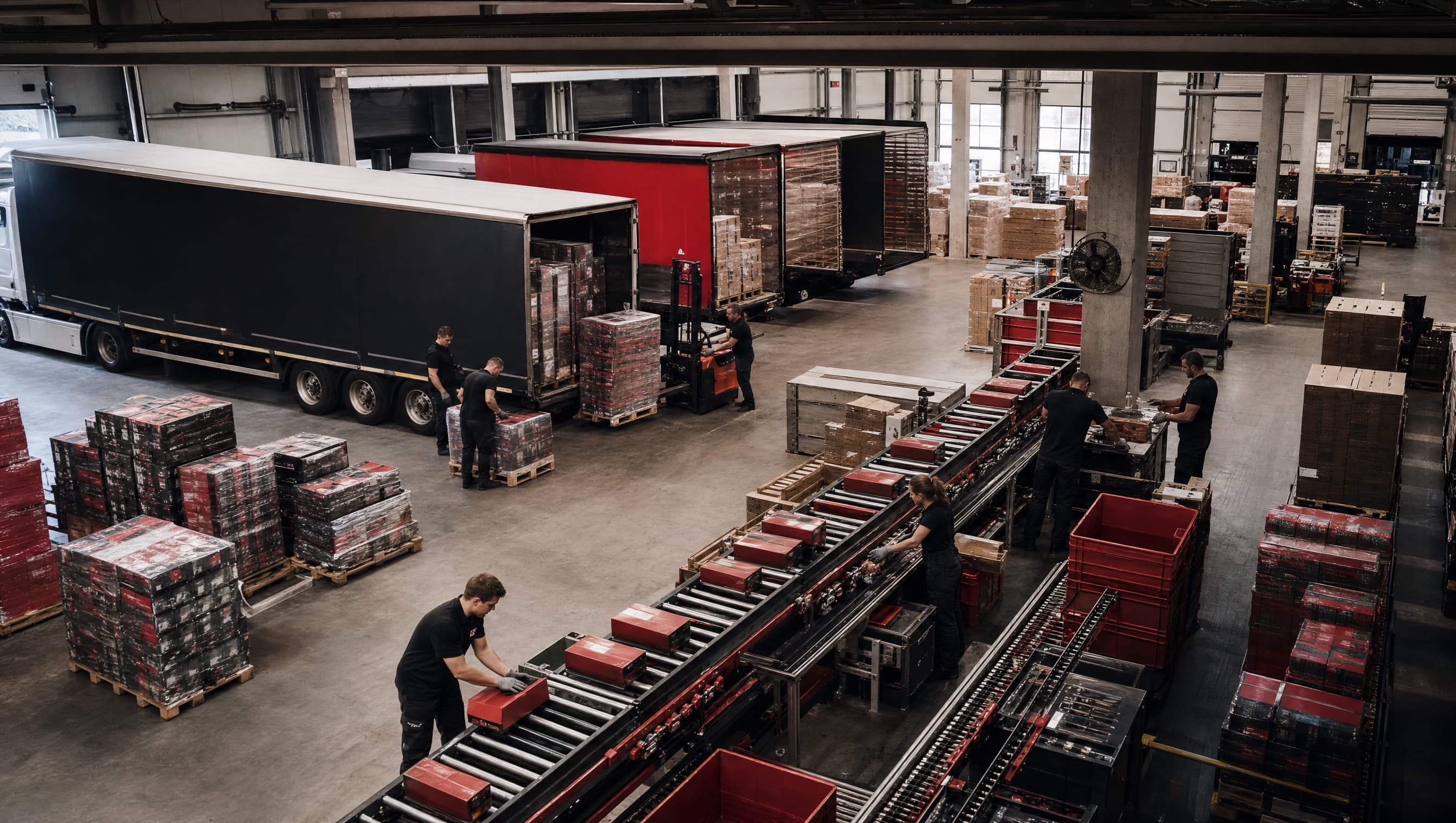
Campaign logistics refers to the logistical handling of time-limited marketing and sales campaigns: inbound delivery, kitting, and scheduled distribution of large volumes within a fixed campaign window. It is the counterpart to ongoing operations — not a continuous flow of orders, but a plannable peak load with a fixed end date. It differs from promotional-products logistics in cadence, and from POS logistics in scope: a campaign may go to the retail outlet, but equally to field staff, consumers, or event sites.
In a campaign, the date is part of the product: flyers are printed, shelf space is negotiated, media are booked. If the material arrives late, it is not the delivery that expires but the campaign — along with every investment attached to it. What matters to decision-makers is therefore not a provider's average capacity but its peak capacity: how much it can handle in a single day, how quickly it retools, and what happens when the campaign grows beyond plan.
Example: a retail campaign starts on Monday. Displays, goods and inserts are assembled to a bill of materials and shipped for the stores’ receiving windows. PROWERB combines assembly and scheduled distribution; the linked service explains campaign-line planning.
Four terms from the same campaign path:
The cadence: ongoing operations are a continuous flow of orders; a campaign is a plannable peak load with a fixed end date. Each demands different infrastructure — ongoing operations demand efficiency per order, the campaign demands peak capacity on call.
The PROWERB campaign line is designed for 1 to 15,000 shipments per day. Throughput for an individual campaign depends on packing instructions, item mix, available components and shifts.
Capacity is added: through a floater pool and shift operations, PROWERB increases capacity to 200 percent of baseline capacity within 24 hours and to 400 percent of baseline capacity within 72 hours. What matters is that this increase is planned — not improvised.
In most cases, yes: campaign sets only come into being through kitting — components become ready-to-ship units, for displays with a synchronized fishbone feed at the line. This is controlled through bill-of-materials processes in PROWERB CORE, the company's own ERP/WMS.
Are timing, goods or execution starting to fail? Send the bottleneck and critical deadline straight into operational review.
