Point-of-sale (POS) logistics refers to supplying points of sale with displays, secondary placements, and sales-promotion material — including warehousing, kitting, and scheduled delivery to retail and hospitality outlets. It is the branch of promotional-products logistics that ends at the retail outlet: the recipient is not the field force or the consumer, but the store, branch, or hospitality business. It overlaps with campaign logistics as soon as the POS equipment is tied to a campaign window.
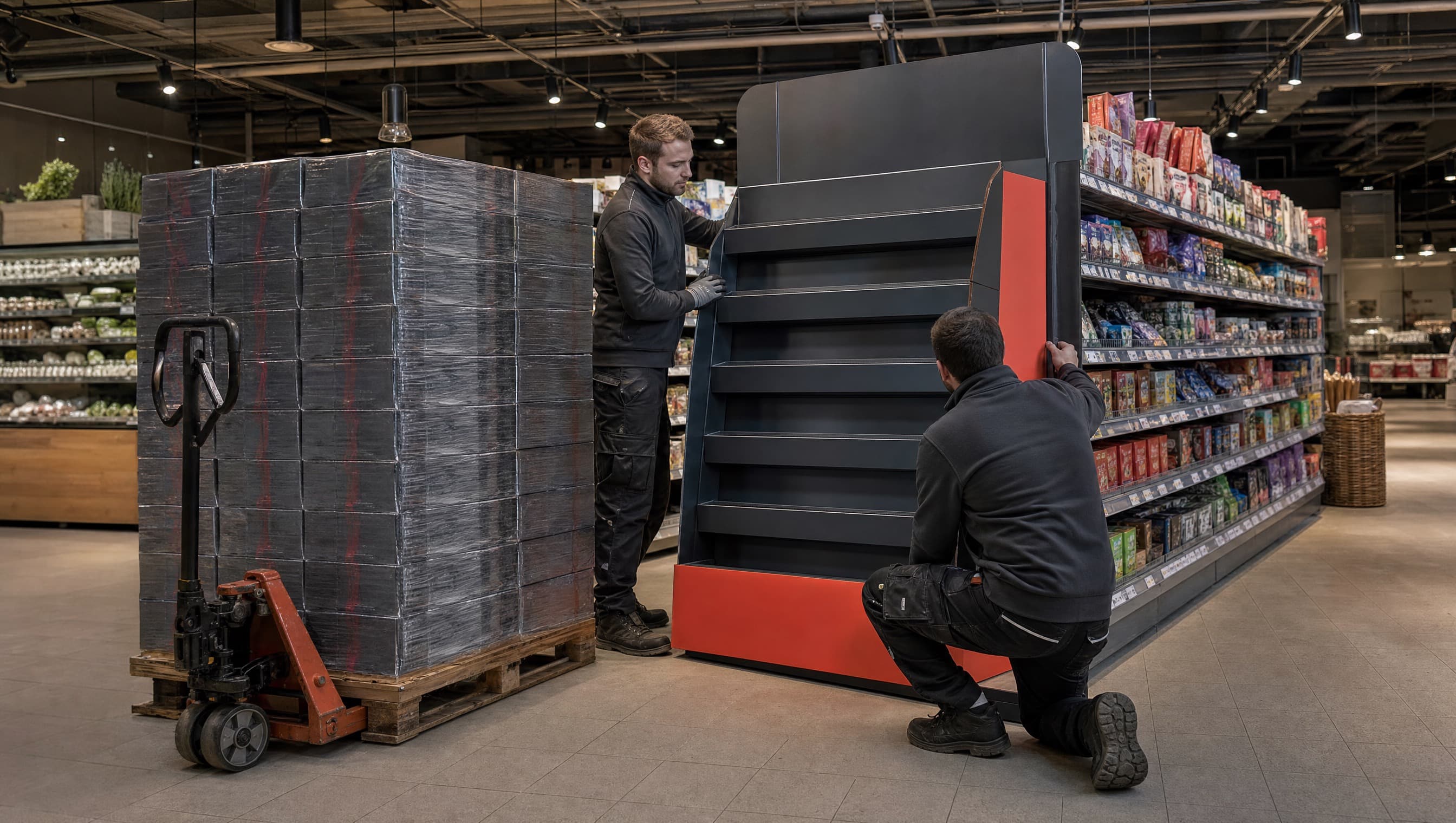
Secondary placements and displays are negotiated space with a date attached: the retailer clears room for a defined time window. If the material arrives late, incomplete, or unfit for assembly, the space stays empty or is filled with something else — and the investment in production and listing evaporates.
For trade-marketing decision-makers, POS logistics is therefore less a freight question than a scheduling question: complete sets, displays kitted and ready, delivery within the store's time window.
PROWERB kits displays on a line with fishbone feed: components arrive from the side in a synchronized cycle, and the display leaves the line fully stocked. Distribution to the retail outlet runs on the same infrastructure as the campaign business with its more than 1,000 campaigns per year — notified in advance and scheduled to the store's delivery window, in the beverage segment for clients such as Erdinger.
Four terms from the same route to the retail outlet:
Warehousing, kitting, and scheduled delivery of displays, secondary placements, and sales-promotion material to points of sale in retail and hospitality. The process does not end at the loading dock but at the shelf space — which is why time windows, delivery notification, and complete, assembly-ready sets are part of it.
In the point of reference: POS logistics is defined by the destination — the retail outlet — while campaign logistics is defined by the time window. As soon as POS equipment is tied to a campaign launch, it falls into both categories.
At PROWERB, as a rule, yes: display kitting runs on a line with fishbone feed, components are fed in from the side in a synchronized cycle, and the display leaves the line stocked. What the individual store accepts is up to the retailer — the process has to support both variants.
Because the space is negotiated: the retailer clears room for a defined time window. If the material arrives late or incomplete, the space stays empty or is filled with something else — and the investment in production and listing is lost.
