Co-packing refers to the packing, repacking, and assembly of products by an external service provider — from bundles to gift sets to stocked displays, built to a bill of materials on behalf of the manufacturer. The term largely overlaps with kitting & assembly; contract packaging emphasizes the client relationship. It should be distinguished from co-manufacturing, which also covers making the product itself — co-packing begins after production.
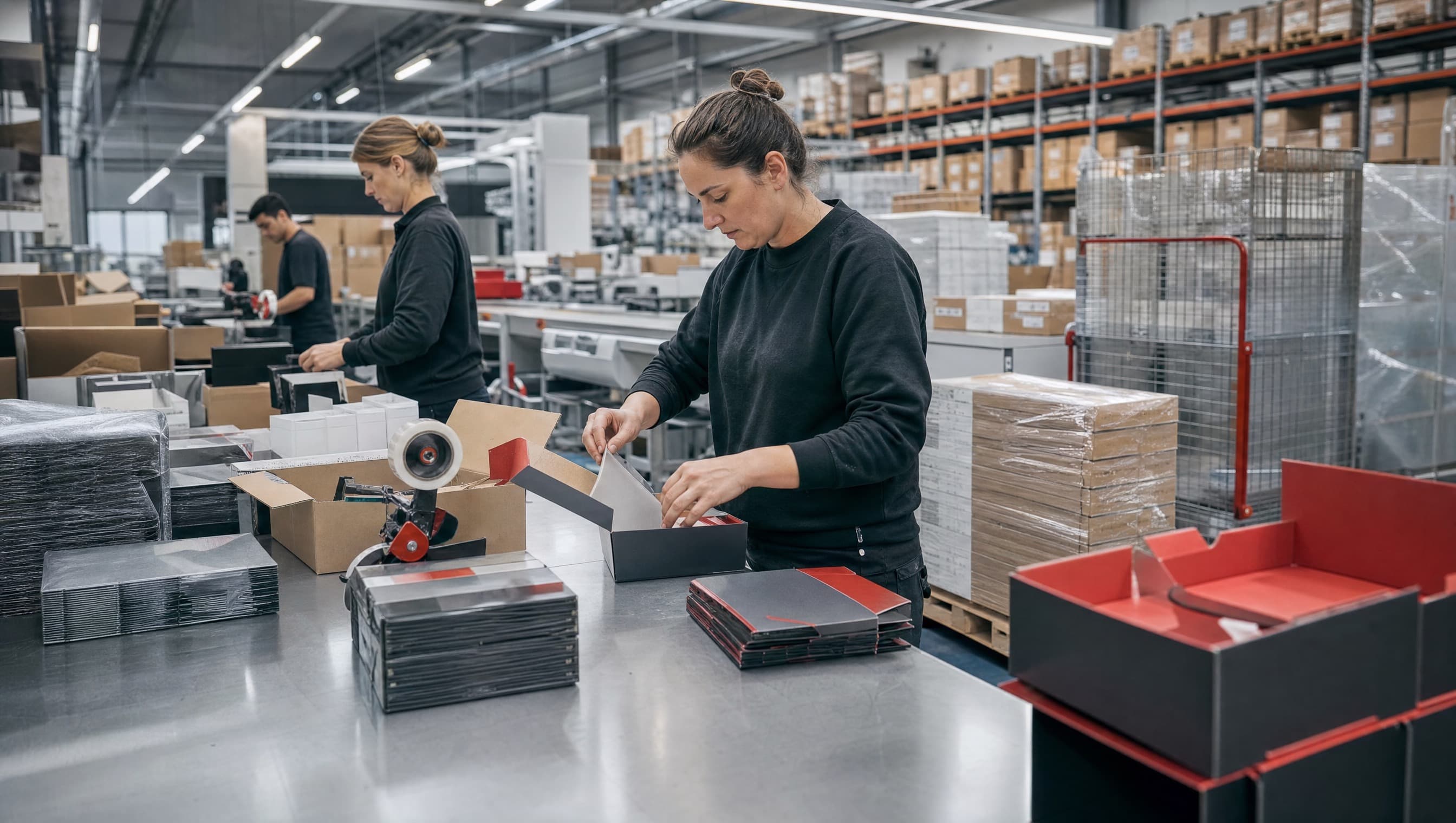
Production lines are built for volume formats. Special formats — campaign multipacks, mixed cartons, sets with add-ons — stop the line or do not pay off there. So the work moves to the co-packer, who maintains manual and semi-automatic capacity that can be retooled per job. For buyers, two things count: that the provider absorbs peaks, and that stock stays correct in the system throughout the conversion.
PROWERB runs co-packing as a bill-of-materials and value-added process in PROWERB CORE, the company's own ERP/WMS: components are booked out, and the finished set is booked in as stock.
When needed, capacity grows to 200 percent of baseline capacity within 24 hours and to 400 percent of baseline capacity within 72 hours — through a floater pool and shift operations, for instance when campaign multipacks for brands such as Erdinger are due.
These peak figures refer to baseline output: 200% is double, 400% is fourfold (+300%). Achievable volume and lead time are agreed for the item mix, goods and data availability, staffing and shift plan.
Four terms from the same field of work:
The terms overlap but are not identical. Co-packing emphasizes contract packing and repacking; kitting and assembly emphasizes creating defined units. A gift set can involve both, while relabelling or repacking need not create a kit.
Co-manufacturing covers making the product; co-packing begins afterwards. The co-packer does not change the product but its sales unit: multipack, set, display, add-on.
Through bill-of-materials-driven booking in the inventory system: components are booked out, and the finished set is booked in as a new item. PROWERB maps this in PROWERB CORE — with real-time inventory tracking throughout the conversion.
At PROWERB, to 200 percent of baseline capacity within 24 hours and to 400 percent of baseline capacity within 72 hours. A floater pool and shift operations make that possible — the line does not wait for new hires. The agreed capacity depends on item mix, goods and data availability, staffing and shifts.
