Skip to content
PROWERB
Services
Industries
Cases
Lab & Software
Company
DENeeds Check →
Services
Industries
Cases
Lab & Software
Company
LanguageDEEN
Start Needs Check →
PROWERB — Elevating Brands

Marketing Operations Backbone since 1979. Promotional products, logistics, kitting and digital commerce. One partner with its own operations in Kleve.

Elevating Brands — since 1979.Kleve · Düsseldorf · Dortmund · Lüdinghausen
Services
Logistics & fulfillmentPromotional products & merchandiseDigital commerce & marketplaceEvents & campaignsKitting, textile & ESGTech & AI
Company
About usLocationsHow we workSustainabilityCareersContactInternationalPress & news
Resources
GuidesInsights archiveGlossaryDownloadsTools & calculatorsCosts & calculationCompare operating models
Contact
PROWERB, Huissener Str. 7–947533 Kleve+49 (0)2821 7218-0info@prowerb.de
© 1979–2026 Prowerb GmbHLegal notice (German)Privacy policy (German)Terms (German)BrandDEEN

All rights reserved. Subject to change. Text and images on this website have in part been created or edited using artificial intelligence.

  1. PROWERB
  2. Lab
  3. Digital-Business

Our software · PROWERB

We develop the application for your process.

Approvals, material orders or campaign planning: PROWERB develops applications that bring these tasks together. We define requirements, build interfaces and integrations, and support ongoing operations.
Discuss your project →Explore the details ↓
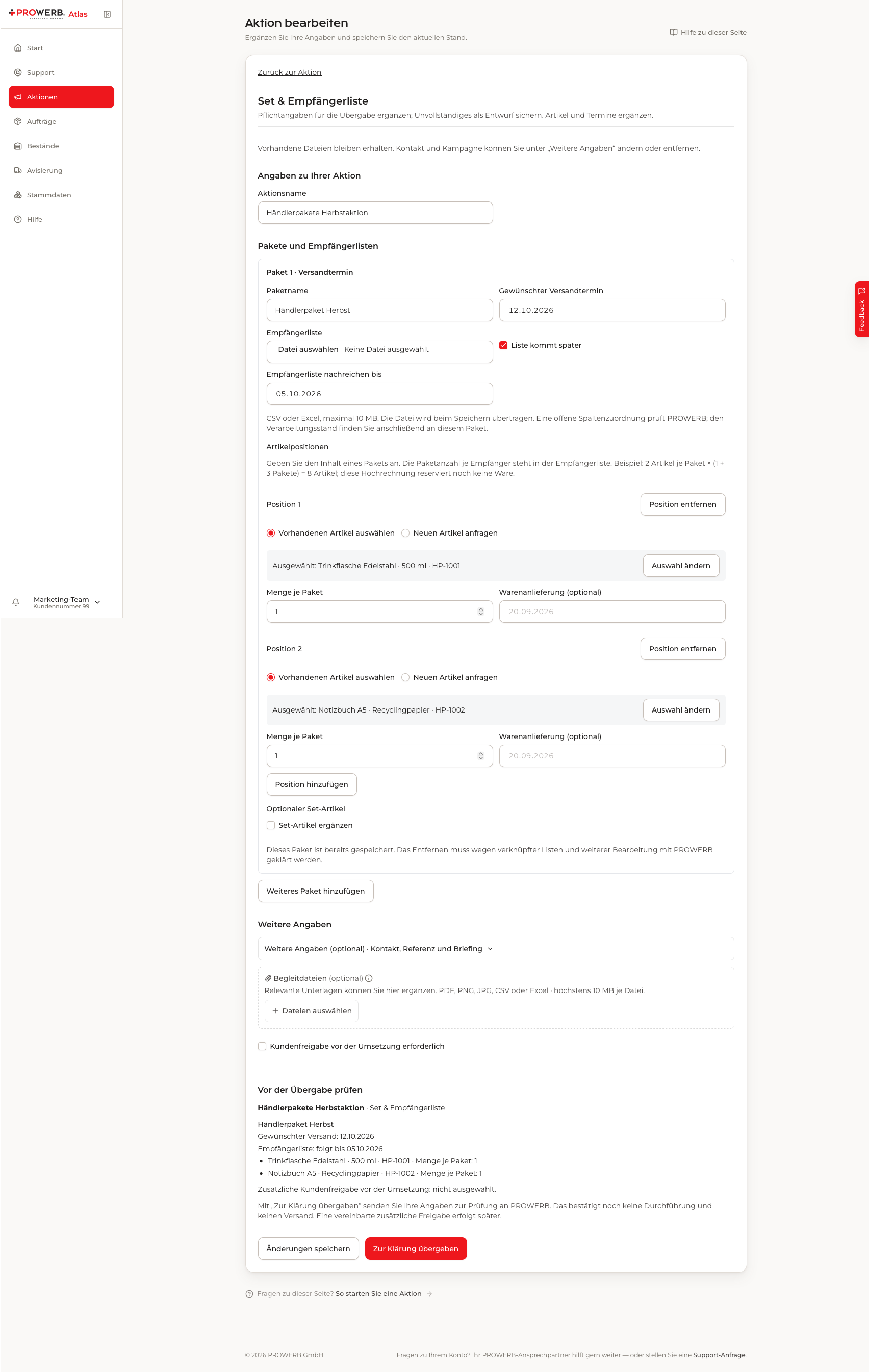
A view from the German-language Atlas client portal developed by PROWERB.
A view from the German-language Atlas client portal developed by PROWERB. Enlarge view

From the task to a useful application

Understand the task

Work with users to identify the decision or job that should become easier.

Try the workflow

Test the interface and data handovers against a concrete process.

Run it day to day

Define ownership, changes and support for ongoing use.

Thesis

A special case the system does not know becomes a spreadsheet.

Spreadsheets can have permissions, versions and history. Difficulties arise when teams coordinate emailed copies, responsibility changes and system data is transferred manually. An application brings current status, named ownership and traceable decisions together in one process.

Atlas & Nexus · PROWERB systems

Planning stays connected to fulfilment.

Atlas gives clients access to products, stock, campaigns and orders. Nexus supports operational processing. We agree the views and handovers needed for your project.

Explore Atlas and Nexus →

Which software fits your task?

MEP and MRM describe tasks in marketing and material management. These are the PROWERB products for shops, campaigns and operations.

Agora Commerce

B2B shops and ordering

Promotion Engine

Digital campaigns and fulfilment

Atlas & Nexus

Client portal and operations

Example workflow

A useful application knows who acts next.

A team coordinates approvals through spreadsheets and messages. Turn this into a guided case with visible inputs, decisions and handovers, without requiring users to understand the technical data model. Custom development is useful when this workflow is well defined and regularly needed.

  1. 1

    Capture the user journey

    Walk through a normal case and an exception with future users. Identify missing information and unnecessary switching.

  2. 2

    Try the prototype

    Test inputs, states and the next action in a clickable flow. Business feedback guides implementation.

  3. 3

    Hand over responsibility

    Deliver roles, data access and maintenance with the application. Give workflow changes a traceable review path.

01 · Scope

Four pieces of work that belong together.

Commissioned separately they become four projects with three handovers. At PROWERB they sit in one hand.

01Business applicationsFront ends and logic for the actual process: approvals, scheduling, stock views, roles and permissions.
02Interfaces and integrationConnection to ERP, warehouse management, shop, marketplace and customer systems — via API, EDI or file transfer.
03AutomationRecurring manual steps become rules: status changes, notifications, reconciliations and reports run without intervention.
04Operation and further developmentAfter go-live, maintenance, monitoring and extension stay with the same team that built it.
02 · Evidence

The proof has been running in-house for years.

PROWERB Core — ERP and warehouse management with a process engine — is an in-house development of this unit: order, item and stock management in one system, RFID-capable, posted in real time, through bills of material into kitting. The Marketing Execution Platform adds 18 modules from promotion planning to the campaign configurator. Print approvals are part of regular operations, including for Telefónica O₂. The customer relationship dates from 2011.

18Modules in the in-house platform
03 · Approach

Four steps to the first usable increment.

  1. 01

    Describe the process

    Who does what today, with which tool and in which order. Only the documented as-is shows where software actually helps.

  2. 02

    Data model and boundary

    Which data the application owns and which it fetches. That decision carries the entire later operation.

  3. 03

    Build in stages

    The first usable increment appears early and is checked in the real workflow — not in a final acceptance meeting.

  4. 04

    Handover into operation

    Roles, permissions, monitoring and contacts are agreed before the application goes live.

Related services

Where the application connects.

01Tech & AI →ERP, WMS, platform and reporting — the system base a new application builds on.
02EDI & System Integration →When the connection is the project itself: order, delivery and invoice data in the agreed format.
03Web development →The same team for websites, portals and shop systems — often the front end to the business application.
04Reporting & Dashboards →What the application produces becomes visible in the Operations Cockpit — live and embedded in your systems on request.
FAQ

Frequent questions about application development.

How does this differ from the MEP platform?

MEP is a finished product with 18 modules. Application development takes over where no module fits — as an addition to the platform or as a standalone application.

Can we start with something small?

Yes. A bounded process with a measurable result is a better entry point than an overall concept that shows nothing for months.

Who operates the application after go-live?

The same unit that built it. The developers sit in Düsseldorf and are directly reachable — not three transfers away.

Can the application connect to our ERP?

Connections run via API, EDI or file transfer. Which route holds is clarified before development, not after.

Briefing

Which process does your system not carry today?

Describe the workflow and the systems attached to it. We check whether a custom application is the shorter route — or whether an adjustment in the existing system is enough.

Start needs check →Your contact replies within 24 hours on business days.